





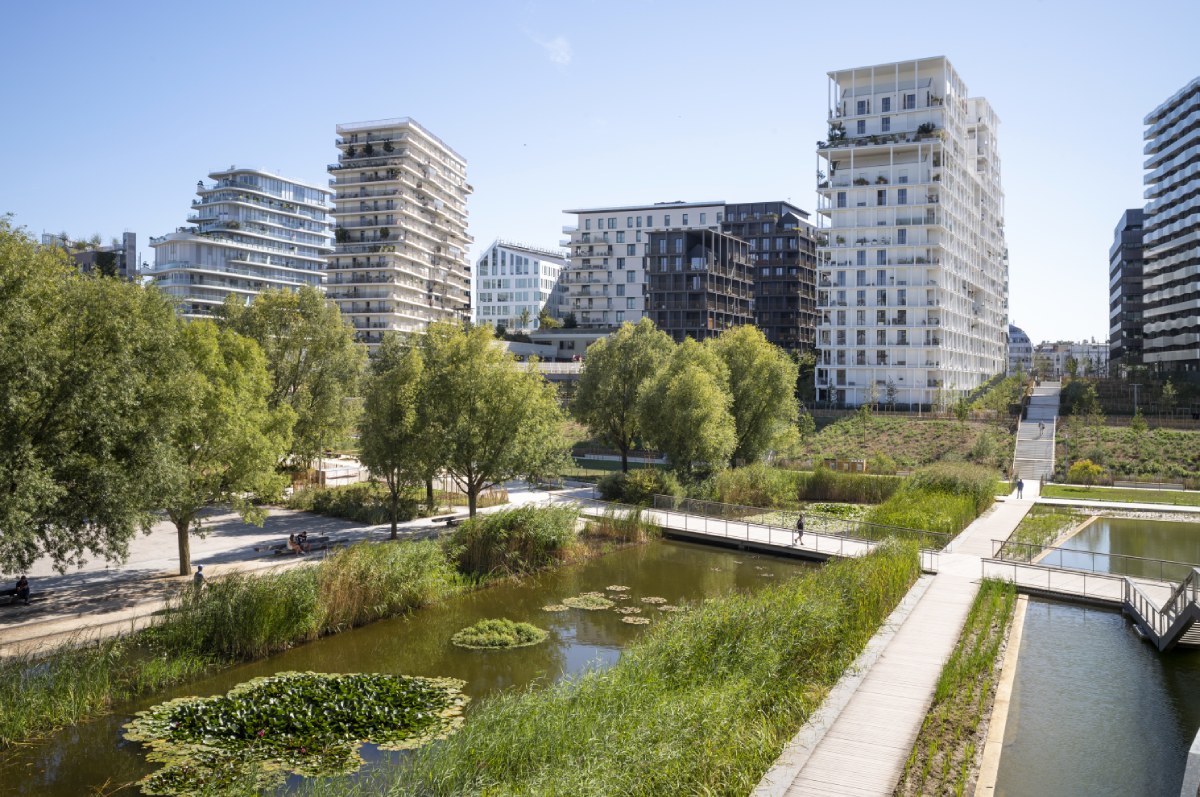


Following four successful annual summer school events with the general title PARIS TRANSFORMATIONS (2022 Paris Transformations I: Architectural, Urban, Metropolitan; 2023_Paris Transformations II: Landscape, Gardens, Urban Parks; 2024_Paris Transformations III: Places of spectacle & 2025 Paris Transformations IV: Places of Fashion ), we are pleased to launch the fifth event in the series for the year 2026, entitled PARIS TRANSFORMATIONS V: SOCIAL HOUSING.
Social Housing in Paris, an architectural and social laboratory
Since the 19th century, social housing has been a crucial component of architectural and urban planning practices addressing the housing crisis caused by the Industrial Revolution and rapid urbanization. From the famous Familistère de Guise, the first workers' housing complex in Napoleon's Paris to the utopian models of socialist thinkers and the radical proposals of the interwar period, social housing has served both as a means of social policy and an object of urban and architectural experimentation in France. Its design and typology has been shaped by the architectural, ideological, political, and technological conditions of each era.
This is exemplified by the establishment of Paris Habitat, a public body founded 131 years ago in Paris, which still manages social housing in the city today. Closely associated with the creation of HBM (Habitations à Bon Marché) in 1894, it now oversees a reach and historic building stock considered parts of Paris’s cultural heritage. Before World War I, social housing was largely the result of philanthropic and hygienist initiatives, often through foundations, with many designs were winning architectural competitions.
1919 marked a turning point when the demolition of the city walls transferred a vast area of undeveloped military land to the State, mainly used for constructing social housing complexes. This peripheral zone with its social housing complexes and its homogeneous architectural expression, became after Haussmann, the second identity defining image of Paris. Between 1921 and 1939, 58.500 HBM dwellings were built. Ensuring sanitary conditions for the middle and lower income classes remained a key goal exemplified by the iconic Rue des Amiraux complex (18e,1927, architect Henri Sauvage), built around an indoor communal swimming pool.
Between 1920 and 1930, many housing estates were built across the greater Paris area, Seine-et-Oise, and Seine-et-Marne. Some social housing complexes began as garden cities, and through successive expansions evolved into large scale residential developments of particular architectural and urban planning interest, such as the garden city of Saint Gervais in Pantin, which was developed between 1927 and 1952. There are also cases of successive expansions of social housing complexes that began as garden cities and gradually evolved into huge residential developments of particular architectural and urban planning interest.
Between 1953-1973 the population growth and immigration, led to the construction of large-scale housing complexes (such as La Caravelle à Villeneuve-la Garenne complex (Hauts-de-Seine,1959 - 67, by the architectJ. Dubuisson), the social housing complexes in Argenteuil, Sarcelles, La Courneuve, Bagneux, Aubervilliers, Creteil. Montreuil, Les Carreaux in Villiers Le Bel, etc. These massive developments defined the modern "banlieue" in Paris areas rich in political, social, and artistic references. Around the same period, the monumental Mouchotte building (arch. J. Dubuisson) was constructed as part of Monparnasse railway station redevelopment.
Contemporary transformations of the Social Housing building stock
With an average age of 67 years and over 128,000 dwellings, Paris’s social housing stock reflects architectural and urban diversity. Paris Habitat has long be engaged in preservation, adaptation and conversion efforts contributing to a greener city and improved quality life for residents.
Today, social housing is redefined in its purpose and scope, with shortages growing more severe amid globalization, economic and climate crises, the
refugee crisis, and the COVID-19 pandemic, reaffirming housing as a matter of social jusitice.
In the 21st century, Parisian social housing has become a field of architecture and urban interventions with the practice of transformation gaining particular momentum. Historical complexes are been reimagined to meet modern needs.
A typical example is the conversion of a large-scale complex (129 m long) for social housing in Jussieu (5e) into 600 student residences.
Architects like Lacaton & Vassal and Frederic Druot, internationally recognized for their approach to conversion rather than demolition, had transformed structures like the Tour Bois le Prêtre - Paris 17e, turning a 1960s tower into a modern, sustainable social housing building. Similar initiatives are underway in La Courneuve complex.
Responding to increasing social housing needs by transforming existing buildings
Transformations also extend to repurposing 19th century or industrial buildings such as Hall Pujol, (a converted railway facilitiy into a multi-use complex that includes social housing, railway stations and infrastructure, the Batignolles station (now Martin Luther King 17e park), and the19th-century Saint Vincent de Paul hospital (now an eco- neighborhood), Other examples include conversions of the La Poste Louvre, from an old post office to a multi-purpose complex with social housing, Caserne des Minimes, and Caserne Exelmans 19th century fire stations and police stations.
The decline of car in the inner city, has also freed large parking spaces for redevelopment, many now converted into social housing. A typical example is the conversion of the garage that belonged to the Van Loo (1958) into a social housing building - prefabricated wooden structures (architects: Atelier WRA). And a garage at 43, rue Laborde (8e) (arch. GENS) into social housing, while sometimes garages are demolished to make way for social housing buildings. (e.g. the transformation of the Jean-Nicot passage (7e).
The search for social housing space is further reinforced by the SRU Law (Lois Solidarite et Renouvellement Urbain, 2000), mandates that roughly 18% of new construction be allocated to social housing, leading to mixted-use projects such as the Samaritaine redevelopment into a complex which integrades retail, hospitality and housing.
Urban transformations in Paris including social Housing
In an effort to address the critical issue of social housing in Paris, plans were made for the use of the facilities after the 2024 Olympic Games after the Games focusing on the Saint Denis area where the decision to convert them into social housing prevailed driving significant architectural and urban transformations.
The Summer School will explore all facets of Paris’s social housing landscape - historical, social, and contemporary- in an effort to highlight the significance of urban and metropolitan transformations through field visits and expert lectures, during a one-week program.
GENERAL STRUCTURE OF THE PROGRAMME
(THE FINAL PROGRAMME, INCLUDING MOST OF THE VENUES MENTIONED ABOVE, WILL BE PUBLISHED IN
DECEMBER 2024)
Sunday July 12th | Arrival in Paris and check-in at the Hellenic Foundation | Visit to the Cité Internationale Universitaire | Cocktail reception at the Hellenic Foundation
Monday July 13th | General presentation of the seminar | Visit 1 | Free Dinner | July 14th cebrations
Tuesday July 14th | All day visits to Social housing projects near Paris
Wednesday, July 15th | Lectures | Visit 3 | Free Dinner
Thursday July 16th | Lectures | Visit 4 | Free Dinner
Friday July 17th | Lectures | Visit 5 | Free Dinner
Saturday July 18th | Final presentation of the collective work | Farewell dinner in Parsian Restaurant
Sunday July 19th | Closing day and Departure.
ELIGIBILITY AND EXPRESSION OF INTEREST
The Summer School is addressed to Undergraduate, Postgraduate and PhD students of Architecture, as well as to young architects who have graduated after 2021.
- Applicants should have a good knowledge of the city's history and architecture.
- Good level in English is essential
- Knowledge of French will be highly appreciated.
Applicants are invited to submit the following documents in a single PDF:
- Application form
- Letter of motivation explaining in detail how the Summer School will contribute to their
studies and professional development.
- Letter of recommendation by a tertiary education professor/senior academic staff
member
- CV
- Portfolio with three works (drawings, architectural projects, architectural works, collages,
photos, texts), related to urban transformations
Deadline for submission of supporting documents FRIDAY 3 April 2026
The PDF with all the supporting documents will be submitted to Fondation.hellenique.adm@wanadoo.fr via mail with the subject title "ECOLE
D'ETE TRANSFORMATIONS".
Shortlisted candidates will be notified by 17 April 2026.
PARTICIPATION COST
The participation fee is 850 euros including:
- 7 nights in a single room (15sqm with private bathroom and kitchenette) at the Fondation Hellénique – “Greek house" or equivalent in the Cité International Universitaire de Paris.
- 6 meals - buffet at the seminar lecture venue - 1 cocktail (welcome reception)
- 1 dinner in a traditional Parisian restaurant;
- 1 weekly metro card covering all travels in Paris and Paris region
- Participation in all program visits and museum entrances
- Attendance of lectures by distinguished speakers
- Organization of the seminar, premises and consumables for the workshop
The amount of 850 euros does not include:
- Travel costs to and from Paris (air tickets, train tickets, etc.)
- Transfer from the airport to the city
- Personal expenses
The participation fee must be paid in two instalments:
- 450 euros until 6 May 2026
- 400 euros until 1st June 2024 to the bank account of Fondation Hellénique.
In case of cancellation for valid reasons before May 25th, 2026, the amount of 450 euros will be refunded. No refunds will be issued after this date.
CONDITIONS FOR VALIDATING THE SUMMER SCHOOL AND OBTAINING THE CERTIFICATE OF PARTICIPATION
The seminar will be conducted in English. Successful completion requires regular and active participation in the whole program in all sessions and workshops. Participants are also invited to submit, within one month after the seminar’s conclusion a project related to its theme (architectural design, sketch, photographs, collage, etc.). This project, first presented as a concept during the seminar will be finalized for inclusion in a publication. Upon successful participation, attendees will receive a Certificate of Participation equivalent to 3 ECTS credits.
SUMMER SCHOOL LOCATIONS
The PARIS TRANSFORMATIONS Summer School will take place at the Hellenic Foundation of the Cité Internationale Universitaire de Paris. The Hellenic Foundation is an institution with a long and distinguished history, serving as a place of residence and inspiration of researchers, artists, architects and Greek intellectuals. Among its notable residents were architects such as Takis Zenetos, Georges Candilis, Aristomenis Provelegios, Yannis Tsiomis etc.
Located in a 34-hectare campus in the south of Paris, easily accessible by public transport the Cité Internationale is an open-air museum of 20th century architecture, featuring works by Le Corbusier, Lucio Costa, Claude Parent, Dudock, etc.
The Hellenic Foundation building, designed by the architect Nicolas Zahos and inaugurated during the interwar period, combines neoclassical elements with Art Deco influences. Fully renovated in 202, it offers equipped with private bathrooms, and kitchenettes.

Archetype team - 18/09/2026
ΣΑΔΑΣ – ΠΕΑ - 17/09/2026
Δρ. Αλέξανδρος Καλλέγιας - 16/09/2026
 ΟΛΑ ΤΑ ΤΕΥΧΗ
SUBSCRIBE
ΟΛΑ ΤΑ ΤΕΥΧΗ
SUBSCRIBE
Μπορείς να καταχωρήσεις το έργο σου με έναν από τους τρεις παρακάτω τρόπους: